
What is microfluidics?
Microfluidics is a scientific discipline and technology that manipulates fluids at the micrometer scale, within channels or miniaturized devices. It takes advantage of physical phenomena such as capillarity and surface forces, which dominate at this scale, to precisely control extremely small volumes of liquids or gases. Its applications are wide-ranging: rapid medical diagnostics (lab-on-a-chip tests), biology (NGS, cell analysis, drug screening), chemistry (molecule synthesis), and engineering (sensors, portable laboratories). Through its ability to automate and parallelize analyses, microfluidics is revolutionizing fields such as healthcare, environmental science, and industry. Microfluidic technologies, often integrated into Lab-on-a-Chip systems, enable faster, less expensive, and more precise analyses than those performed in traditional laboratories.
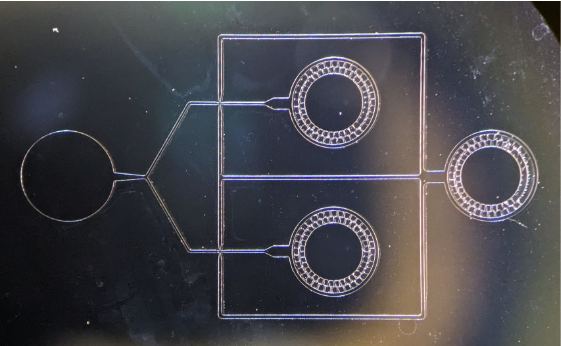
A microfluidics chip
The origins of microfluidics can be traced back to the 1950s and 1960s, with the first studies of microchannels for electronics and cooling systems, particularly in the aerospace field. In the 1980s, the invention of micropumps and microvalves (notably by researchers such as Stephen Terry) marked a turning point, making it possible to manipulate fluids at the microscale. The 1990s saw the rise of Lab-on-a-Chip technologies, popularized by George Whitesides’ work on PDMS (polydimethylsiloxane) microchannels, revolutionizing biology and chemistry. Since the 2000s, microfluidics has expanded into medicine (rapid diagnostics), industry (fluid-based 3D printing), and even organs-on-chips for medical applications, with increasingly innovative applications.
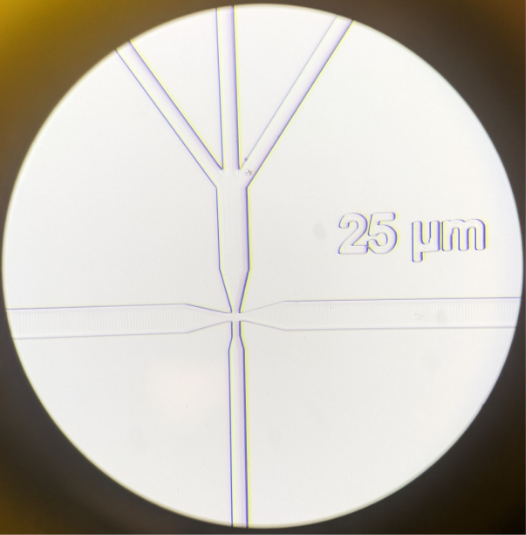
A microfluidics channel
Microfluidics applied to plants
Plant microfluidics is an emerging field that uses miniaturized devices to study and manipulate plant biological processes at the cellular or tissue level. For example, it makes it possible to analyze sap circulation in real time, study responses to environmental stresses (drought, pathogens), and investigate nutrient uptake using microfluidic chips that mimic plant tissues. These tools also facilitate the study of root interactions with soil microorganisms and the screening of molecules for more sustainable agriculture. Finally, microfluidic systems are being developed for the in vitro culture of plant cells, opening up new opportunities in biotechnology and crop improvement.
Microfluidics within Bordeaux Metabolome
The ambitious project to establish a microfluidics laboratory within the platform focuses on the study of enzymes involved in central metabolism in plants, with the aim of improving predictive models used in systems biology. Microfluidics makes it possible to multiplex the conditions under which these enzymes are studied, particularly by varying their interactions with different substrates, inhibitors, or effectors, in order to reproduce physiological conditions as closely as possible. Each droplet produced at high throughput within the chips acts as a microreactor, in which biochemical reactions are monitored through fluorescence emission.
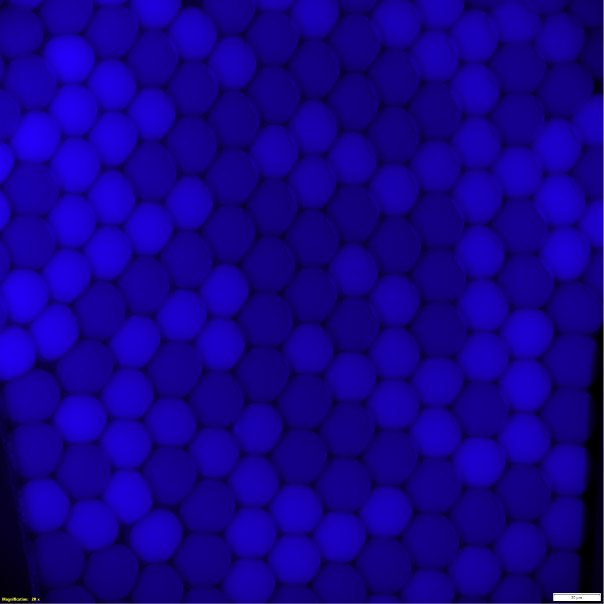
Some droplets
Other applications quickly emerged, such as the sorting of labeled particles using microchannels and electric fields to separate droplets according to their fluorescence. Another collaborative project aims to couple microfluidic particle sorting with mass spectrometry.
Equipment
- Two observation systems mounted on Olympus inverted microscopes (SpectraX and LedHub LED light sources, fluorescence and high-speed cameras, Cetoni syringe pumps, and Fluigent flow controllers)
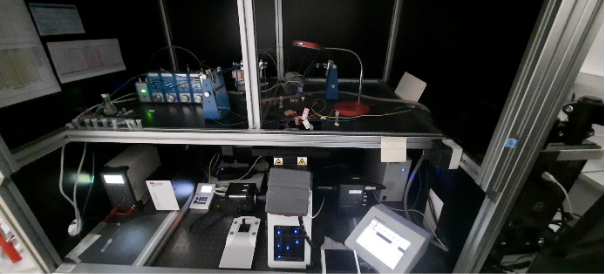
- A cleanroom equipped for the fabrication of microfluidic chips (spin coater, plasma oven, KLOE Dilase 650 laser photolithography system)
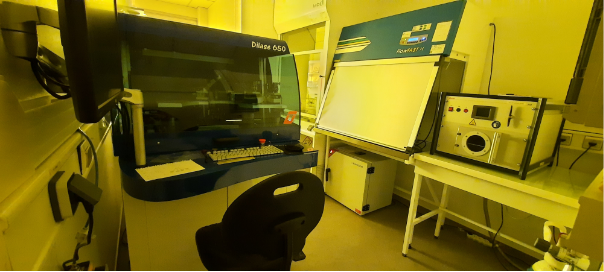
- A high-resolution KLOE Dilase 3D printer
Images: © Bordeaux Metabolome, INRAE/CNRS/University of Bordeaux — CC BY 4.0.